Showing posts with label FITS Viewer. Show all posts

Thursday, December 5, 2024

KStars v3.7.4 is Released

KStars v3.7.4 is released on 2024.12.05 for Windows, MacOS & Linux. It's a bi-monthly bug-fix release with a couple of exciting features.

Imaging Planner

Hy Murveit added a brand new Imaging Planner in KStars to facilitate imaging.

The Imaging Planner tool helps users choose which objects to image. Users can download catalogs of recommended objects, or possibly create and share their own catalogs. The tool computes when the objects in a read-in catalog may be imaged on the selected night given constraints such as minimum altitude, terrain and moon separation.

It can sort the objects along several different dimensions including the number of hours an object may be imaged tonight (given the users geography, constraints and possibly artificial horizon), its peak altitude, distance from the moon, constellation, name and type. Objects can also be filtered out for several reasons (e.g. type of object, whether it was previously imaged, keywords the user has added, whether the object has been selected, user not interested, etc). 

This tool helps users research the objects by showing small images of the objects, showing the objects' sky locations on the skymap, and by providing links to follow to internet sites with more information and images. It allows users to attach notes and links to objects, and select certain of them for further consideration. This tool can be used in conjunction with the Ekos imager or any other imaging tool. It does not currently directly interact with the actual imager; it only helps the user decide what to image.

Simbad Integration with FITSViewer

John Evans added a new, experimental feature to the FITSViewer that allows the user to dynamically query the SIMBAD astronomical database and highlight the results on the image in the FITSViewer. The user draws a circle on the image and the objects within that circle are then displayed in a table and on the image.

It is possible to filter by object type and click through to the Simbad / CDS or NED websites for more information about the objects.


This is an interesting tool to see what is in your image, be it a subframe whilst you are imaging or a completed image that you have reloaded into the FITSViewer.

In order to use the feature you will need an internet connection to access the online Simbad database and an image must have WCS enabled within the FITSViewer. For the most accurate results, plate solve the image with the build-in FITSViewer plate solver. The feature is controlled by a toggle in the FITSViewer options.

New Focus Measures

John Evans introduced a new contrast based focusing algorithm suited for solar and planetary imaging. 

4 new focus measures have been added to the Focus Module to complement the existing measures of HFR, FWHM, etc.
·      StdDev. This is similar conceptually to the Fourier Algorithm but is simpler. It uses an algorithm based on the standard deviation of the pixels in the image as the measure of focus. It can be used on star fields.
·      Contrast based measures use algorithms that can be found in other areas of image processing and uses the contrast of texture in the image in various way as a measure of focus. The following measures are available:

o   Sobel
o   Laplassian
o   Canny

These measures require some form of extended object in the image so will not work on star fields. They are intended for Solar, Lunar and planetary focusing.


These algorithms can be used on the whole image or with the existing mask features, or with a user-defined region-of-interest that is used in single-star mode for star based focusing measures.
 
This new feature requires the openCV library to be installed (a standard installation is fine). This library is not installed by default with Kstars so anyone wishing to use these features will need to first install openCV and then rebuild Kstars on their system. It will not be available with pre-built executables.

Sunday, December 3, 2023

KStars 3.6.8 is Released


KStars v3.6.8 is released on 2023.12.03 for Windows, MacOS & Linux. It's a bi-monthly bug-fix release with a couple of exciting features.

Aberration Inspector


John Evans introduces the very exciting Aberration Inspector tool. The Aberration Inspector is a tool that makes use of Autofocus to analyze backfocus and sensor tilt in the connected optical train. It solves up to 9 virtual tiles on the sensor as defined by the existing Mosaic Mask.


The information is then used to analyze:
  • Back focus.
  • Sensor Tilt.
There are 4 sections:
  • V-curve for the each tile.
  • Table of data detailing the curve fitting results.
  • Analysis of back focus and tilt.
  • 3D Surface graphic to explain the Petzval Surface intersection with the sensor.
This release provides display only functionality. In future it would be possible to add functionality to offer recommendations for adjustments using Octopi, PhotonCage, etc.

Sub-exposure Calculator


Joseph McGee continues to add improvements and fixes for the Sub-exposure calculator. For usability, the window is now re-sizeable, an issue with the display of tool tips was corrected, and an indicator has been added for the sensor type of the selected camera (Mono / Color).  For functionality: the upper limit of the Noise Increase input parameter was increased, support was added for cameras with non-variable read noise, (cameras with CCD sensors).


Several new camera data files were added to the KStars source code repository, and a function to allow direct direct download of camera files from the repository was enabled. (Note: users who have created their own camera data files, may wish set the file attribute to read-only, and/or make a back up copy in case of an accidental over-write from the download function if the camera file has the same name).

A new experimental graphical tool to determine an appropriate number of sub-exposures for integration was added. This tool allows the selection of an exposure time to noise ratio for a stacked image; the tool will compute the number of sub-exposures required to achieve that value.

Added several new camera data files:
  • Atik-16200CCD_Mono.xml
  • FLI-16200CCD_Mono.xml 
  • QHY_CCD_294M_Pro.xml
  • QHY_CCD_461_PH.xml
  • QHY_CCD_163C.xml 
  • QHY_CCD_163M.xml
  • QHY_CCD_268C.xml
  • QHY_CCD_294M.xml
  • QHY_CCD_600_PH.xml
  • ZWO_CCD_ASI294MC
  • Pro.xml ZWO_CCD_ASI294MM
  • Pro.xml ZWO_CCD_ASI533MC
  • Pro.xml ZWO_CCD_ASI2600MC
  • Pro.xml ZWO_CCD_ASI6200MC
  • Pro.xml ZWO_CCD_ASI533MC
  • Pro.xml ZWO_CCD_ASI533MM
  • Pro.xml Nikon_DSLR_DSC_D5100_(PTP_mode).xml Nikon_DSLR_DSC_D700_(PTP_mode).xml

FITSViewer Solver


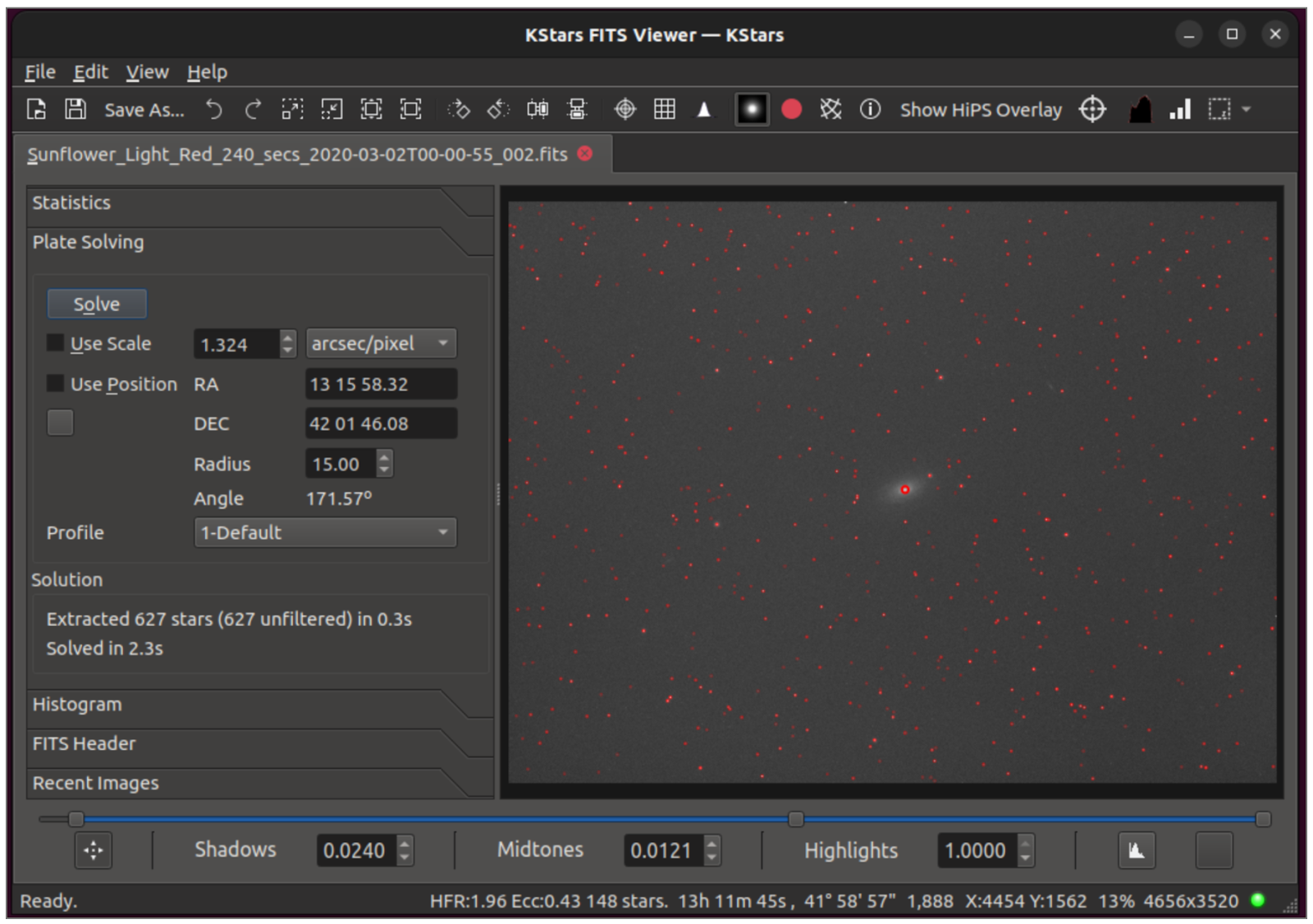
Hy Murveit added a very useful feature to the FITS Viewer: a built-in solver!

The FITS Viewer Solver is used to plate-solve the image loaded in the FITS Viewer's tab. It only works with the internal StellarSolver. You get the RA and DEC coordinates for the center of the image, the image's scale, the angle of rotation, and the number of stars detected in the image. Its main use case is debugging plate-solving issues in Ekos, though the information displayed can be generally useful. The controls and displays are described below.


This adds a new tool inside the splitter on the FITS Viewer. It plate-solves the displayed image, and allows the user to experiment with a number of plate-solving parameters, and thus help debug plate-solving issues.

How to test it out?
  • Open the sliding panel on the left part way, click on Plate Solving, and resize the windows appropriately.
  • Experiment with the parameters available (Use Scale, Use Position, the scale and RA/DEC positions, choose a profile and/or edit it)
  • Click Solve, and the image is solved and the solution presented in the Scale and RA & DEC and Angle boxes.
  • If you enable "Mark Stars" above the image window, you will also see the stars that were detected.

Quality of Life improvements

  • Make "Set Coordinates Manually" dialog more intuitive.
  • Telescope name specified in the optical trains are now saved in the  FITS header (the mount name was saved before).
  • New placeholders for ISO, binning and pure exposure time added.
  • Add a new not-default scheduler option to disable greedy scheduling.
  • Reduce latency between captures, especially when guiding / dithering.
  • Fix issue with differential slewing.
  • Separate Business Logic from UI in Scheduler.
  • Fix bug in estimating job time, capture delays were misinterpreted.
  • Fixed guide start deviation was not saved properly in esq file.
  • Bugfix in one-pulse dither. Dither pulses were going the wrong way.
  • Fix Scheduler hangs when Focus does not signal Autofocus start failure.
  • Focus Guide Settle Bug.

Monday, April 27, 2020

KStars v3.4.2 is Released

Glad to announce the latest release of KStars v3.4.2 on April, 27th, 2020 for Windows, MacOS, and Linux.

This release brings even more stability enhancements to KStars in addition to better memory management, especially on embedded devices.

FITS Viewer Memory


Hy Murveit submitted patches to reduce memory usage of FITS Viewer tool, sometimes by up to 50%.

The maximum zoom factor was hard-coded to 400% in the FITS View. However, it now dynamic (On Linux & MacOS, Windows in the next release). On systems with limited memory, the maximum zoom is at 100%, while if you have 16GB+ RAM available, you can zoom in up to 600%.

Testing Framework


This is an under-the-hood improvement in KStars championed by Eric Dejouhanet to standardize unit and GUI tests for KStars in order to ensure reliability and detect any regressions that might affect the code. While this will not affect end users directly, it greatly enhances KStars reliability in the long term.

INDIHub Support


Preliminary support for INDIHub project by Dennis Zaytsev. INDIhub is a global networks of telescopes powered by INDI. You can share your equipment with others, or can opt in for remote robotic operation to help in scientific studies. This is in the very early phases of development and the KStars team shall add more support to INDIHub integration in the upcoming releases.

Improvements & Bug Fixes

  • Correct bug in median computation
  • Re-enabled the Jupiter's Moons tool
  • Add a warning if the dust cap is missing instead of total abort.
  • Fixed KStars deadlock on disconnecting from INDI server.
  • Mount box layout corrected so that everything fits well into the window
  • SEP Focus improvements

Thursday, January 2, 2020

KStars v3.3.9 is Released

We kickoff 2020 with a brand new KStars v3.3.9 release for Windows, MacOS, and Linux.

This release incorporates the continued improvements to KStars base while introducing new long-awaited features in a few areas.

Stretch Controls


Hy Murveit implemented adjustable and fast stretch controls for mono and color images within the FITS Viewer. These allow fine changes in Shadows, Midtones, and Highlights clipping even for high resolution astro-photos.

Adjusting the controls do not change the underlying data, only the previewed image. After any stretch adjustment is made, the user can always revert to the automatic stretching again by clicking on the small wizard icon at the bottom right corner of the controls panel.


Experimental Linear Focusing Algorithm


Hy Murveit developed a new experimental linear focusing algorithm.  Linear focuser is a simple autofocus algorithm that always scans in, sampling at regularly spaced intervals. It may be slower than the other algorithms, but the hope is that by minimizing direction changes backlash will be minimized and the algorithm may provide more stable autofocus results.

This change also introduces an interface that hides the implementation of the autofocus algorithm, and future changes may moved the other existing algorithms into this framework.

Linear focuser mainly works well when started near the ultimate focus position. It depends on the step-size, max-travel, and tolerance parameters, which should be chosen well. It may take more iterations to find focus than the other algorithms.


Piotr Zyziuk improve Focus Module in Ekos by adding autofocus support for DSLR's that use manualfocusdrive command by gphoto instead of rel_focus_position for example, Nikon Z6 manual focusing only works in the "liveview" aka "preview" mode (with mirror up). In "non preview" mode the focus motor is only controllable by the autofocus engine. This change should also be applicable to Canon cameras.


New western Sky Culture


KStars now includes an option for a new standard western sky culture, thanks to work by Edgar Scholz over at sternenkarten.com. The constellations from this sky culture are based on work by H.A. Rey. They are often more intuitive and easier to remember than the classical Greek and Roman inspired constellations. The new sky culture mixes the best more intuitive representations from both worlds in addition to completely new shapes painted by Mr. Scholz himself.

Aquarius in a different Sky Culture

Bug Fixes


  • Bugfix for re-connecting a weather device initializes the weather display.
  • Fix off-by-one bug in stretch.
  • Fix video streaming resize crash on Windows.
  • Fix minor EBN issues.
  • Account for exposure less than 0.001 seconds in the file name.
  • For windows, when index 1 is selected from the combo box it should be considered REMOTE.
  • Bugfix for re-connecting a weather device initializes the weather display.
  • Making the Columns in the Align view resize automatically.
  • Add markers for the documentation configuration pages, add some info about sky cultures
  • Abort plate solving when slewing is detected.
  • Fix crash when focused object is either asteroid or comet and the data is loaded.
  • Fix bug re filter-change-autofocus.
  • Reset guiding calibration if the mount moves and "Always Reset Guide Calibration" option is set.