Showing posts with label Mosaic. Show all posts

Thursday, May 26, 2022

KStars v3.5.9 Released

KStars v3.5.9 is released on 2022.05.26 for MacOS, Linux, and Windows. It's a bi-monthly bugfix release with a couple of exciting features.

DSS Offline HiPS

HiPS (Hierarchical Progressive Surveys) is a technology that provides progressive high resolution images of the sky at different zoom levels. KStars fully supports online HiPS where data is downloaded from online servers and cached to display on the Sky Map.


One of the most popular catalogs in KStars is the DSS Colored progressive survey. With v3.5.9, you can now specify directory where the offline DSS catalog is located. You can download the data from various HiPS services online. For best experience, it's recommended to download 3rd, 4th, and 5th (Norder3, Norder4, and Norder5) order directories which would take around 1GB of storage space. You may download further orders (i.e. higher zoom levels) at the expense of more storage space.

The following shows a sample of downloaded order directories, at minimum you need Norder3 folder for this functionality to work.


Revamped Mosaic Planner

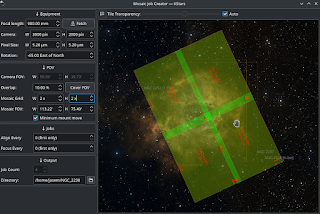
New simplified and powerful Mosaic Planner directly integrated in the Sky Map. It greatly benefits from HiPS overlay to make your target framing spot on. Toggle the Mosaic View from the tool bar, and select your equipment and the mosaic configuration. You can also use it as a very simple tool to frame a single 1x1 tile.
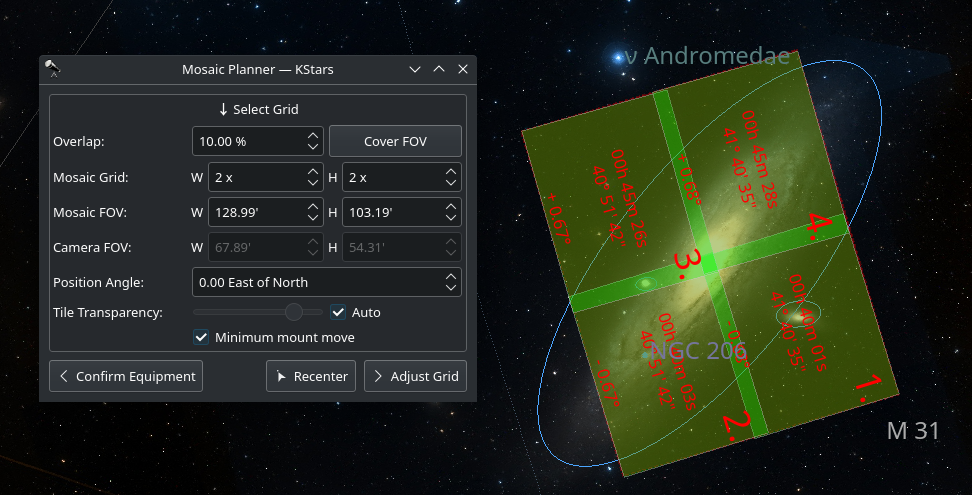


Adjust the tile center either by manually specifying the J2000 center or by dragging the tiles across the sky map. Once done, you can command the mount to go to the target and solve. Alternatively, you can proceed to create jobs for the Ekos Scheduler. After the jobs are added, you may start the scheduler at any time to plan the mosaic session accordingly.

Refocus After Meridian Flip


Dušan Poizl
 added the ability to refocus after a meridian flip is complete. This is very useful for some optical train setups where the focuser might shift duration the flip.

New Index Files


Robert Lancaster added the new 5200 astrometry index files. The difference is just which star surveys were used to build which indexes. The 4200 Series was made from 2MASS and covers all the image scales. The 4100 series was made from Tycho2 but only covers wide image scales. The 5200 series was just recently added, was made by blending Tycho2 and Gaia, and complements the 4100 series to give it the smaller scales.

Internal Plumbing: Introducing Device Adapter

Wolfgang Reissenberger continues his outstanding work refactoring Ekos state machine by introducing the device adapter. Next step extracting state handling from Capture into a dedicated state machine. In this step devices are managed by a dedicated device adapter (successor of the command processor). With this refactoring it is no longer necessary to route device events from Capture through SequenceJob to the state machine, the device adapter sends the events directly to the state machine.

Capture Progress face lift


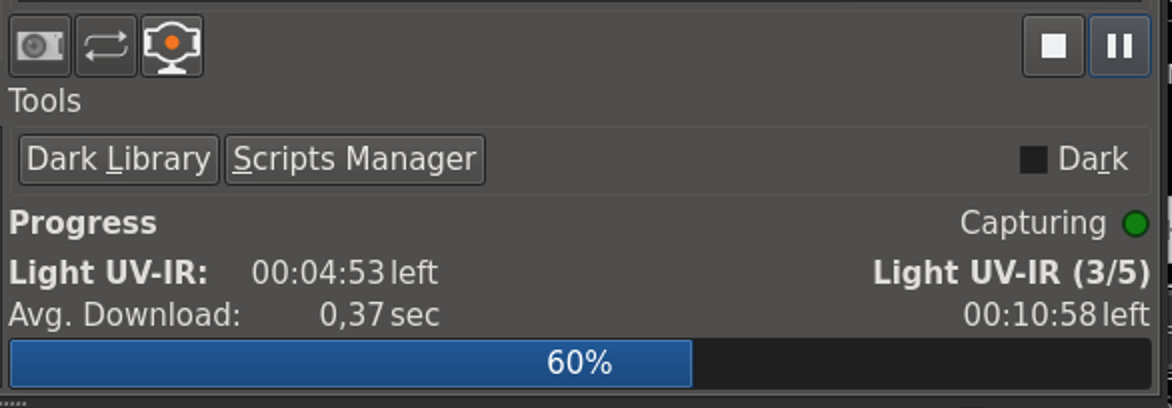
Wolfgang Reissenberger streamlined the capture progress section of Capture:

  • Remaining time for frame and sequence displayed as hh:mm:ss
  • Display of average download time (in calculation, all download times are taken into account and not only those > 1)
  • New status widget with a color LED displaying the capture status (and no longer using the seconds text for this)
  • Using the same widget on the Master tab 
Greedy Scheduler Speeds up
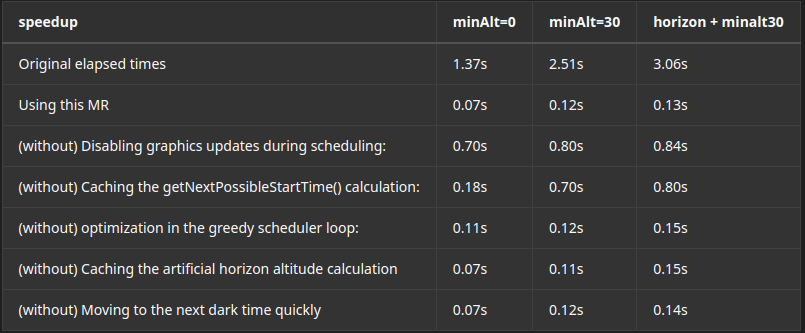

Fans of Greedy Scheduler rejoice! Hy Murveit made significant speedups to the Greedy Scheduler, especially for very large scheduler. 


Tuesday, January 18, 2022

KStars v3.5.7 Released

KStars v3.5.7 is released on January 18th for Windows, MacOS, and Linux. This release includes a number of new features and bug fixes.

Mosaic Dragging


This feature is finally implemented in 3.5.7. Many assumed it existed before and were disappointed when they couldn't drag the mosaic panels around for finer adjustments.


Better MacOS support


Robert Lancaster worked vigilantly on improving KStars & INDI support for MacOS. This includes working on all the plumping required to get a daily build going in KDE Binary Farms using KDE's Craft technology so that MacOS users may finally have access to nightly builds.

Flat Darks


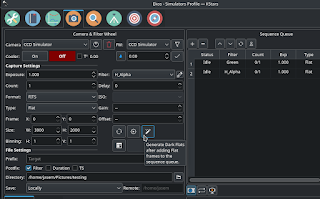
Capture Flat Darks with a click of a button. After adding your desired flat frames, simply click the Flat Dark generator icon to add Dark Flats to your sequence queue. When Ekos completes capture of the flat frames, it will use the same exposure time (per filter, if one exists) for the dark flats. 


Please note that for this to work, the flats must be captured in the same session. That is, you cannot partially capture flats, restart Ekos, and then proceed to capture dark flats.

Comets Visibility


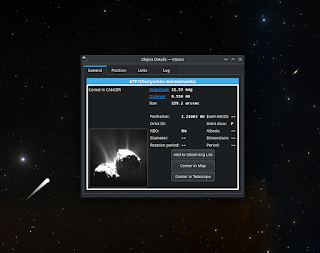
Hy Murveit made comets more discoverable in KStars by displaying them on almost all zoom levels. You'll find a lot more comets to learn and discover about in this release.


Internal refactoring


Wolfgang Reissenberger introduced State Machine for Capture Control changes as part of Ekos Road map to separate state machines, command processors, and business logic into their own manageable silos. While this is not exactly a user-facing activity, it remains to be critical for Ekos stability and growth in the future.


Faster Dithering


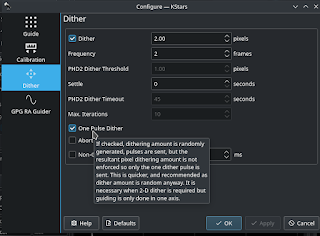
Hy Murveit introduced a One Pulse Dither option in Ekos guide module with randomly generated pulse. This should reduce the time it takes to dither at the expense of verifying that the guide star moved by the specific number of pixels required. Experiment with this new option and let us know what you think!


More highlights

  • Wolfgang Reissenberger: Bugfix for capture guiding deviation recovery
  • Eric Dejouhanet: Mosaic Tool documentation update
  • Akarsh Simha: Fix bugs involving the reading and writing of user's notes (logs) on objects
  • Wolfgang Reissenberger: Deactivating meridian flip while PAA is running
  • Paweł Pleskaczyński: change guide graph style to line graph
  • Wolfgang Reissenberger: Display FITS viewer only when option is set
  • Jasem Mutlaq: Compressed FITS image with fpack are now properly loaded in KStars when they are sent as buffer
  • Antonio Escriban: Standardized dialog for guider 'Control Parameters' &'Other Settings'
  • Hy Murveit: Display comets at almost all zooms, default names now 1AU.
  • Jasem Mutlaq: Extend properties that can be saved in a sequence file beyond just numbers

Monday, September 11, 2017

KStars 2.8.3 aka Tommy is out!

The bugfix release of KStars 2.8.3 is available for all major platforms (Note: MacOS version is delayed to 2017-09-13). In this version, we finally managed to release translations for Windows & MacOS users, thanks to the efforts of Hannah and Kevin over at Craft, and the KDE translation team.

KStars in Arabic
A major bug that was fixed is inaccurate asteroid and comets positions. After exhaustive troubleshotting with the aid of JPL Horizon ephemeris, the problem was traced to imprecise Earth ecliptic longitude angle. The Earth coordinates are important if we want to calculate positions of solar system bodies from a geocentric point of view. Valentin traced the problem to problematic VSOP87 files and promptly generated new data files that solves the discrepancy in Earth ecliptic longitude.

However, while that greatly improved the accuracy, it was still a bit off. While checking KStars Florence (1981 ET3) asteroid position against that of Stellarium, I noted KStars epoch of date position exactly match the J2000 position reported in Stellarium! This was not a coincidence, it turns out we didn't account for precession in KStars. After that is taken care of, the comet and asteroid positions are now accurate on the order of arc-seconds! This is a 100-fold improvement in accuracy from previous versions.


Several fixes and improvement to Ekos with fixes in PHD2 support along with the ability to disable streaming from remote cameras right from the guide module. Another issue that was resolved is the focus module always running autofocus even when the HFR is below the threshold. This was tricky to trace down as it was due to a switch of HFR algorithms when the HFR check is first requested. For those using domes, the align module now properly waits until a slaved dome reaches its target before proceeding with image capture. More over, the Mosaic Tool was simplified and now dragging the mosaic grid produces precise jobs for all orientations.

Numerous stability improvements from GSoC 2017 projects made it into the release. GSoC 2017 student Csaba Kertesz concluded the project and KStars is now much more bullet-proof than before.

This release is named after my lovely loyal German Shepard Tommy! Isn't he a good boy?

Tommy